MTK SH

04 / Think / iOS

Frames

A little structure. A clearer thought.

Organize ideas with 67 thinking frameworks, from SWOT and priorities to reflection. Capture what matters and decide on your next step.

Start with a question on your mind and choose a framework that fits. Prompts and worked examples help you give ideas a shape, then review them as a diagram or list. Export your note or a blank worksheet as a single-page A4 PDF.

In App Store review

Currently in App Store review. A release date has not been announced.

Frames

At a glance

Category
Think
Requires
iOS 18.0+
Availability
In App Store review
In-app language
12 languages, including English, Japanese & Chinese
Developer
MTK SH

What you can do

  • 0167 frameworks, including SWOT, importance/urgency, and KPT
  • 02Explanations, prompts, and worked examples to start a blank or sample note
  • 03Review diagrams and lists, then record key insights and next steps
  • 04Export notes or blank worksheets as single-page A4 PDFs, or share text

FROM SCREEN TO PAPER

Take your thinking onto one A4 page.

Export a note and its summary as a PDF to print or share. A blank worksheet lets you step away from the screen and think by hand.

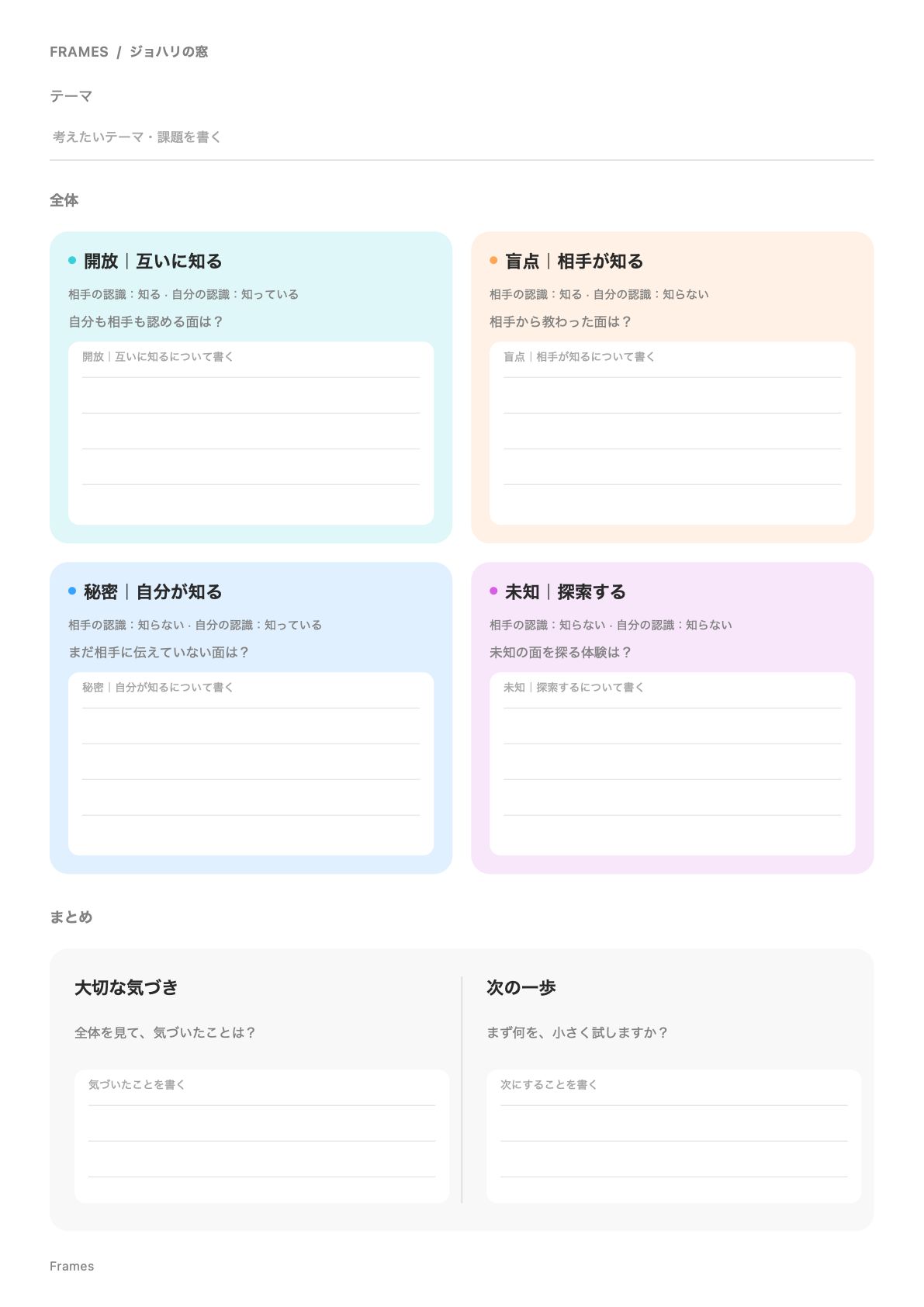
Export example: Johari window

Explore how you see yourself through two questions: what do you know about yourself, and what do others know? This example is a blank worksheet with prompts and space to write.

Theme
A space for the topic or question you want to explore.
Four perspectives
Open, blind, hidden, and unknown areas, with prompts and ruled writing space.
Summary
Key insights and a next step on the same sheet.

A4 portrait · 210 × 297 mm · 1 page

Filled notes can also be exported. Dense notes use smaller text to fit the page.

An A4 Johari window worksheet exported from Frames, with a theme, four areas, key insights, and a next step.
A blank Johari window worksheet. This actual export is in Japanese.

THE FRAMEWORKS

Find a frame for what’s on your mind.

67FRAMES

Set priorities, compare options, or reflect on an experience. Explore 67 frameworks across 11 purposes. Open a group to see how each frame works, when to use it, and a question it can help with.

PrioritiesImportance × Urgency · Impact × Effort · MoSCoW3

Importance × Urgency

Sort tasks by two questions: does it matter to my goals, and is the deadline close? Known as the Eisenhower Matrix. The important-but-not-urgent box is where real progress hides.

When to use it
When everything feels urgent and you need to decide what to do, schedule, hand off, or drop.
A question to try
Which of today’s twelve requests do I handle first?

Impact × Effort

Place ideas on a map of expected effect versus effort. High effect with low effort is where to start; low effect with high effort can usually wait.

When to use it
When you have more ideas than time and need to pick a few.
A question to try
Which product improvements go into next quarter?

MoSCoW

Set the time frame and purpose first. Avoid making everything a Must. Won’t means outside this delivery, not never needed.

When to use it
Decide the scope of the current delivery.
A question to try
Prepare the first book club meeting
Compare and decideWeighted comparison · Pros and cons · Force field analysis4

Weighted comparison

List your options, choose the criteria that matter, weight them, and score each option. The total is not the answer — it shows what drives your preference.

When to use it
When comparing several options across more than one factor.
A question to try
Which of three job offers fits me best?

Pros and cons

List the advantages and disadvantages of one option. Counting is not enough — star the items that weigh most for you.

When to use it
When facing a yes-or-no choice about a single option.
A question to try
Should I accept the transfer abroad?

Force field analysis

List the forces driving a change and the forces resisting it. Often it is easier to weaken a resisting force than to push harder.

When to use it
When planning a change and you expect resistance.
A question to try
How can we roll out a new tool without pushback?

PMI

Consider each perspective before deciding. Use Interesting for possibilities or questions, and do not decide by counting entries.

When to use it
Explore benefits, drawbacks, and interesting possibilities.
A question to try
Work somewhere different once a week
ReflectStart / Stop / Continue · 4Ls · KPT8

Start / Stop / Continue

Three columns: what to start, what to stop, what to continue. It turns vague dissatisfaction into concrete changes in behavior.

When to use it
After a project, a month, or a habit has run for a while and you want to adjust it.
A question to try
How do we change the way our team runs meetings?

4Ls

Reflect with four prompts: what you loved, loathed, learned, and longed for. Feelings come first, then lessons, then wishes for next time.

When to use it
When you want to turn an experience into learning, not just a list of problems.
A question to try
What should our next sprint do differently?

KPT

Keep what worked, name the Problems, and choose something to Try. Link each Try to the Problem it addresses.

When to use it
For a short, regular retrospective with a team or yourself.
A question to try
What do we change before the next release?

Sailboat retrospective

Your team is a boat heading to an island. Wind pushes you forward, anchors hold you back, rocks are risks ahead. The metaphor makes it easy to talk openly.

When to use it
For a team retrospective or when planning toward a shared goal.
A question to try
What is slowing our project down?

What / So What / Now What

Separate what happened, what it means, and what to do next. This is an individual note-taking adaptation of a group reflection and dialogue method.

When to use it
When reviewing an experience and choosing a next action without mixing observations and interpretations.
A question to try
What can we learn from what actually happened at a workshop?

Gibbs Reflective Cycle

Choose one experience and distinguish facts, feelings, evaluation, and analysis. Turn conclusions into action and revisit them after the next experience.

When to use it
Reflect on one experience, including your feelings.
A question to try
Reflect on facilitating a workshop

Learning Card

Use this after a Test Card and distinguish observations from interpretations. Avoid generalizing from a small sample and record the next test or decision.

When to use it
Turn an experiment into learning and a next decision.
A question to try
Learn from a lunchtime book club trial

Creative Destruction (LS TRIZ)

This adapts the Liberating Structures dialogue method for individual notes. It is distinct from engineering TRIZ and its inventive principles. Focus on changeable behavior, not blame.

When to use it
Find counterproductive habits and decide what to stop.
A question to try
Stop behavior that silences a meeting
Understand a situationSWOT · 3C analysis · PEST analysis8

SWOT

Look at a situation through four lenses: strengths and weaknesses inside you, opportunities and threats around you. The value comes from pairing them — which strength can catch which opportunity?

When to use it
When you need an honest picture of where you stand before choosing a direction.
A question to try
Should I apply for the new role that just opened?

3C analysis

Look at the Customer, the Competitor, and your own Company side by side. A good strategy sits where customers’ needs meet your strengths and competitors are weak.

When to use it
When choosing how to position a product, service, or yourself.
A question to try
Should our café focus on remote workers?

PEST analysis

Scan the outside world through four lenses: Political, Economic, Social, and Technological. It reveals trends you cannot control but must prepare for.

When to use it
When a long-term decision depends on changes in the wider environment.
A question to try
Is it a good time to enter this market?

BCG matrix

Place products or activities by market growth and relative market share: stars, question marks, cash cows, and low-growth, low-share items. It helps balance where to invest.

When to use it
When allocating limited resources across several products or projects.
A question to try
Which product line deserves more investment?

SIPOC

Map Suppliers, Inputs, Process, Outputs, and Customers to see a process at a high level. This five-part version omits the additional Constraints and Measures fields.

When to use it
When you need to clarify process boundaries and handoffs before improving the work.
A question to try
Who supplies what for registration, and who receives the result?

Claim–Support–Question

Separate claims from evidence and record sources and conditions. Consider contrary evidence; unresolved questions are useful.

When to use it
Examine a claim, its evidence, and remaining questions.
A question to try
Would shorter meetings increase discussion?

Five Forces

Define the industry and time period and note your sources. This examines industry structure and value distribution rather than scoring one company’s strengths.

When to use it
Examine competition through five industry forces.
A question to try
Examine local learning services

Cynefin

Classify contexts, not people or merit. This five-domain record omits detailed boundaries and transitions. Revisit the category as circumstances change; experiments in Complex should contain the impact of failure.

When to use it
Match your approach to the nature of the situation.
A question to try
Choose approaches for different team challenges
Explore causesFive whys · Logic tree · Cause classification tree4

Five whys

Ask “why?” about a problem, then ask it again about the answer, up to five times. Each step moves from the symptom toward a cause you can actually fix.

When to use it
When the same problem keeps coming back despite quick fixes.
A question to try
Why do our releases keep slipping?

Logic tree

Break a big question into smaller branches until each one is concrete enough to act on. Branches should not overlap and together should cover the whole.

When to use it
When a problem feels too large or tangled to tackle directly.
A question to try
How can we cut monthly costs by 10%?

Cause classification tree

Group possible causes of a problem into categories, such as people, methods, tools, and environment, then list candidates under each. Based on the Ishikawa (fishbone) diagram.

When to use it
When a problem may have many causes and you want to avoid fixating on one.
A question to try
Why are customer complaints rising?

A3 Problem Solving

This canvas records the reasoning from background to follow-up. Explicitly connect causes and countermeasures and revise earlier sections as evidence changes. Filling the form is not the same as solving the problem.

When to use it
Connect the current condition, causes, countermeasures, and follow-up.
A question to try
Reduce registration waiting time
Plan actionPDCA · Small project canvas · 4P14

PDCA

A loop of Plan, Do, Check, Act. Decide how you will judge the result before you start, then run a small test and improve.

When to use it
When you are unsure what works and can afford to learn by trying.
A question to try
Will a new onboarding email improve sign-ups?

Small project canvas

A one-page canvas: who it is for, their problem, the value you offer, what you will try, what you need, and how you will know it worked. Each box should support the others.

When to use it
When an idea needs to become a plan you can start this week.
A question to try
Is this community workshop idea worth running?

4P

Design an offer through four choices: Product, Price, Place (how it reaches people), and Promotion. Check that the four tell one consistent story.

When to use it
When planning how to bring something to its audience.
A question to try
How should we price and sell our new online course?

GROW

A coaching sequence: clarify the Goal, describe the current Reality, widen the Options, then commit to what you Will do. Go back a step whenever the picture changes.

When to use it
When you or someone you support is stuck and needs a way forward.
A question to try
How do I move toward a management role?

5W2H

Check a plan against seven questions: What, Why, Who, When, Where, How, and How much. Gaps show up as blanks; mark them as undecided instead of guessing.

When to use it
Before committing to a plan, to make sure nothing important is missing.
A question to try
Are we ready to announce the new policy?

Gap analysis

Describe where you want to be, where you are now, the gap between them, and the actions that close it. Use the same measures for both states.

When to use it
When you have a goal and need to plan the concrete steps to it.
A question to try
What would it take to reach conversational English by next year?

WBS

Break a deliverable into smaller parts, then those parts into pieces small enough to manage. It shows the full scope of the work.

When to use it
When a project feels big and you need to see everything it includes.
A question to try
What is really involved in launching our website?

SMART

Shape a goal so it is Specific, Measurable, Achievable, Relevant, and Time-bound. Then rewrite it as one clear sentence.

When to use it
When a goal is vague and you need one you can act on and check.
A question to try
What exactly is our sales target for this quarter?

WOOP

Work through Wish, Outcome, Obstacle, and Plan in that order. Take time to imagine the outcome and your inner obstacle, then make an if–then plan.

When to use it
When a goal is clear but a habit or feeling keeps getting in the way.
A question to try
How can I keep reading after dinner?

Test Card

Define one hypothesis, a test, a metric, and a decision threshold before experimenting. This note format records one hypothesis at a time.

When to use it
When you want to test an idea on a small scale before committing more resources.
A question to try
Would people sign up for a lunchtime book club?

15% Solutions

Find actions within your current freedom and resources, without extra permission or resources. The 15% is a metaphor. These three fields adapt a shared consultation method for individual notes.

When to use it
When a large challenge feels overwhelming and you want an action you can start now.
A question to try
What can I start myself to improve information sharing?

Sky, Rain, Umbrella

Sky is fact, rain is interpretation, and umbrella is action or a solution. Separate what you know from what you infer, then decide what to do.

When to use it
When reporting a situation or deciding how to respond to a problem.
A question to try
How should we respond to low event registrations?

Purpose-to-Practice

Revise the five elements together. This can prepare an individual draft, but discuss it with participants before treating it as a shared agreement.

When to use it
Connect purpose with people and ways of organizing.
A question to try
Start a community book club

Opportunity Solution Tree

Connect an outcome to opportunities, solutions, and assumption tests using parent links. Opportunities may have sub-opportunities. Unlinked entries are drafts. Use concrete customer experiences as evidence; scoring and conclusions are not automatic.

When to use it
Connect outcomes, opportunities, solutions, and assumption tests.
A question to try
Help people create their first note
Expand ideasSix Thinking Hats · SCAMPER · Double Diamond6

Six Thinking Hats

Edward de Bono’s Six Thinking Hats: look at one topic through facts (white), feelings (red), caution (black), benefits (yellow), creativity (green), and process (blue). Everyone wears the same hat at the same time.

When to use it
When a discussion is going in circles or one viewpoint dominates.
A question to try
Should our team adopt a four-day week?

SCAMPER

Seven prompts to reshape an idea: Substitute, Combine, Adapt, Modify, Put to another use, Eliminate, Reverse. Generate first, judge later.

When to use it
When you need fresh options rather than a choice between existing ones.
A question to try
How could we reinvent our standard product package?

Double Diamond

Two rounds of opening up and narrowing down: discover the problem and define it, then develop solutions and deliver one. Expect to loop back as you learn.

When to use it
When you are not yet sure you are solving the right problem.
A question to try
What should our new service actually solve?

How Might We

Turn observations into a “How might we…?” question without prescribing a solution. These three note-taking stages help refine the question.

When to use it
Before generating ideas, when you need to focus on whose problem to address and in what setting.
A question to try
How might we help newcomers speak at a book club?

ERRC: Four actions

Use industry norms to consider what to Eliminate, Reduce, Raise, and Create. This four-category view does not draw a value curve.

When to use it
When you want to rethink an existing service and change both buyer value and cost.
A question to try
How can we make a book club easier to join?

Wicked Questions

Describe a tension between two truths without making either side wrong. This individual note helps resist discarding one side or rushing to a solution.

When to use it
Explore two truths that are in tension.
A question to try
Shared rules and local autonomy
Understand othersEmpathy map · Customer journey · Stakeholder map5

Empathy map

Map what another person says, thinks, does, and feels. Separating observed facts from guesses keeps you from projecting your own view onto them.

When to use it
When a decision depends on understanding someone else’s needs.
A question to try
What does the customer actually need from our next feature?

Customer journey

Follow a person through the stages of an experience — discovering, trying, continuing — and note actions, feelings, and ideas at each step. Pain points become visible in context.

When to use it
When deciding where to improve a service or product experience.
A question to try
Where do new users give up on our app?

Stakeholder map

Map the people involved by their interest and influence on your project. It suggests who to involve closely, keep satisfied, keep informed, or monitor.

When to use it
When a decision affects many people and needs their support.
A question to try
Who must we consult before changing the office layout?

Circle of Viewpoints

Use one entry per perspective, recording a view and a question. Distinguish imagination from what people actually said and do not assume their feelings.

When to use it
Explore the same situation from different perspectives.
A question to try
Change library opening hours

Jobs to Be Done

This is a note-taking canvas for circumstances and desired progress. Ask about actual choices, not only requested features. It is not a standard form covering the whole JTBD theory.

When to use it
Understand the progress someone seeks in a specific situation.
A question to try
Understand learning through audio on a commute
CommunicatePREP · STAR · SBI feedback6

PREP

Structure a message as Point, Reason, Example, Point. Lead with the conclusion, support it, then restate it so the listener remembers.

When to use it
When you need to explain or argue for a decision clearly and quickly.
A question to try
How do I propose a budget increase to my manager?

STAR

Tell an experience as Situation, Task, Action, Result. Focus on what you yourself did and on evidence for the outcome.

When to use it
When choosing and preparing a story that proves what you can do.
A question to try
Which experience should I use in my interview?

SBI feedback

Structure feedback around a specific Situation, observed Behavior, and its Impact. Describe what happened without assuming personality or intent.

When to use it
When you want to give appreciation or discuss improvement using a concrete event.
A question to try
How can I explain what helped during a meeting?

Message

Build a message around the issue, your answer, and the response you want from the recipient. The answer includes how you evaluated the matter and reached your conclusion.

When to use it
When a proposal or report needs a clear answer and an explicit response from its audience.
A question to try
What agreement do I seek when proposing a change to meetings?

Ladder of Feedback

Clarify before giving feedback, then share value, concerns, and suggestions. Focus on the work or idea rather than judging the person.

When to use it
Move from understanding an idea to constructive suggestions.
A question to try
Give feedback on a proposal

Seven Elements of Negotiation

Distinguish assumptions about the other party from confirmed facts. BATNA is a feasible alternative if no agreement is reached, not a demand made to the other party.

When to use it
Prepare for negotiation using interests and alternatives.
A question to try
Discuss a venue for a workshop
Know yourselfRubber band · Feedback analysis · Johari window6

Rubber band

Picture yourself held between two forces: what keeps you where you are and what pulls you toward something new. Naming both shows what you would not want to lose.

When to use it
When you are torn between staying and changing.
A question to try
Should I leave a stable job to start something of my own?

Feedback analysis

When you make a decision, write down what you expect. Later, compare it with what actually happened. Over time you learn where your judgment is strong — an approach described by Peter Drucker.

When to use it
When you want to improve the quality of your own decisions over time.
A question to try
Was hiring this candidate the right call?

Johari window

Four windows: what both you and others know about you, what only others see, what only you know, and what no one knows yet. It shows how feedback and openness can widen shared understanding.

When to use it
When deciding what to share or what feedback to ask for.
A question to try
What should I ask my team about how I lead?

Connect–Extend–Challenge

Use this after reading, a lesson, or an experience. Record how your understanding changed, rather than only summarizing the content.

When to use it
Connect new learning to existing knowledge.
A question to try
Reflect on what a book taught you

9 Whys

This explores purpose, not causes of failure. Add successive questions and answers in the reasons section without forcing nine repetitions. This is an individual record of a dialogue method.

When to use it
Explore the purpose behind an activity.
A question to try
Why organize a book club?

Odyssey Plans

Explore three different possibilities rather than ranking a first and backup choice. Stages represent years and lanes represent plans. In Overview, note each plan’s resources, appeal, confidence, coherence, and questions. Written assessments replace the original visual gauges.

When to use it
Explore three different five-year futures.
A question to try
Explore the next five years of work
Consider risksPremortem · Rumsfeld Matrix · FMEA3

Premortem

Imagine it is the future and your plan has failed. List why, what early signs would warn you, and what you can do now to prevent it.

When to use it
Before launching a plan, when optimism may hide risks.
A question to try
What could sink our product launch?

Rumsfeld Matrix

Map known knowns, known unknowns, unknown knowns, and unknown unknowns. The final field is adapted for recording ways to discover or prepare for the unexpected, rather than listing unknowable facts.

When to use it
Before a project or decision, when you want to identify knowledge gaps and what to investigate next.
A question to try
What has been checked before launch, and what remains uncertain?

FMEA

Use one record per failure mode and separate its effects, causes, controls, priority rationale, actions, owner and due date, and results. This is a qualitative record. It does not calculate severity, occurrence, detection, RPN, or Action Priority, or determine standards compliance.

When to use it
Connect failure modes and effects with actions and follow-up.
A question to try
Prepare for failures in event registration

Frameworks included in the submitted version. Each has an explanation, prompts, and a worked example. You can also start with a blank note.

A look inside

01 — 03
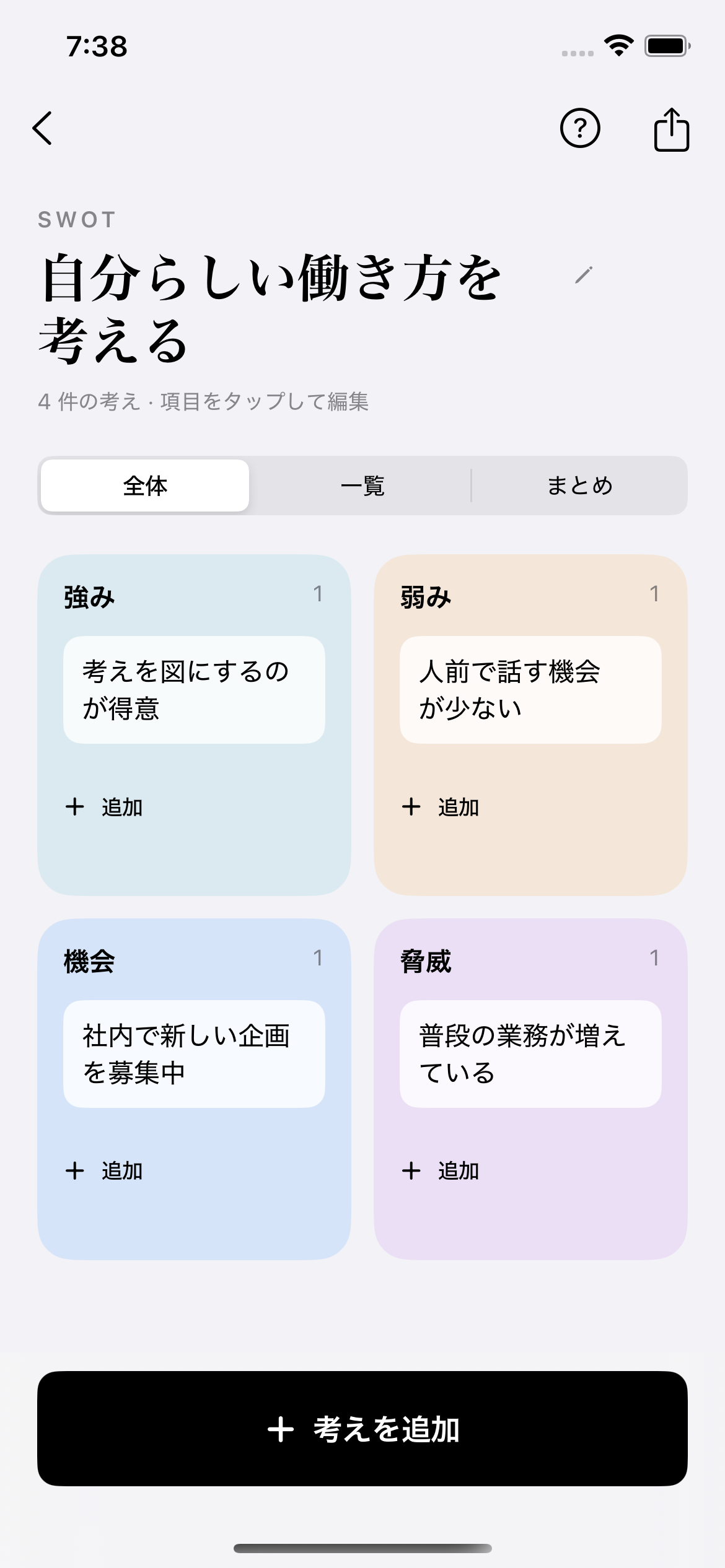
Frames — Organize strengths, weaknesses, opportunities, and threats with SWOT
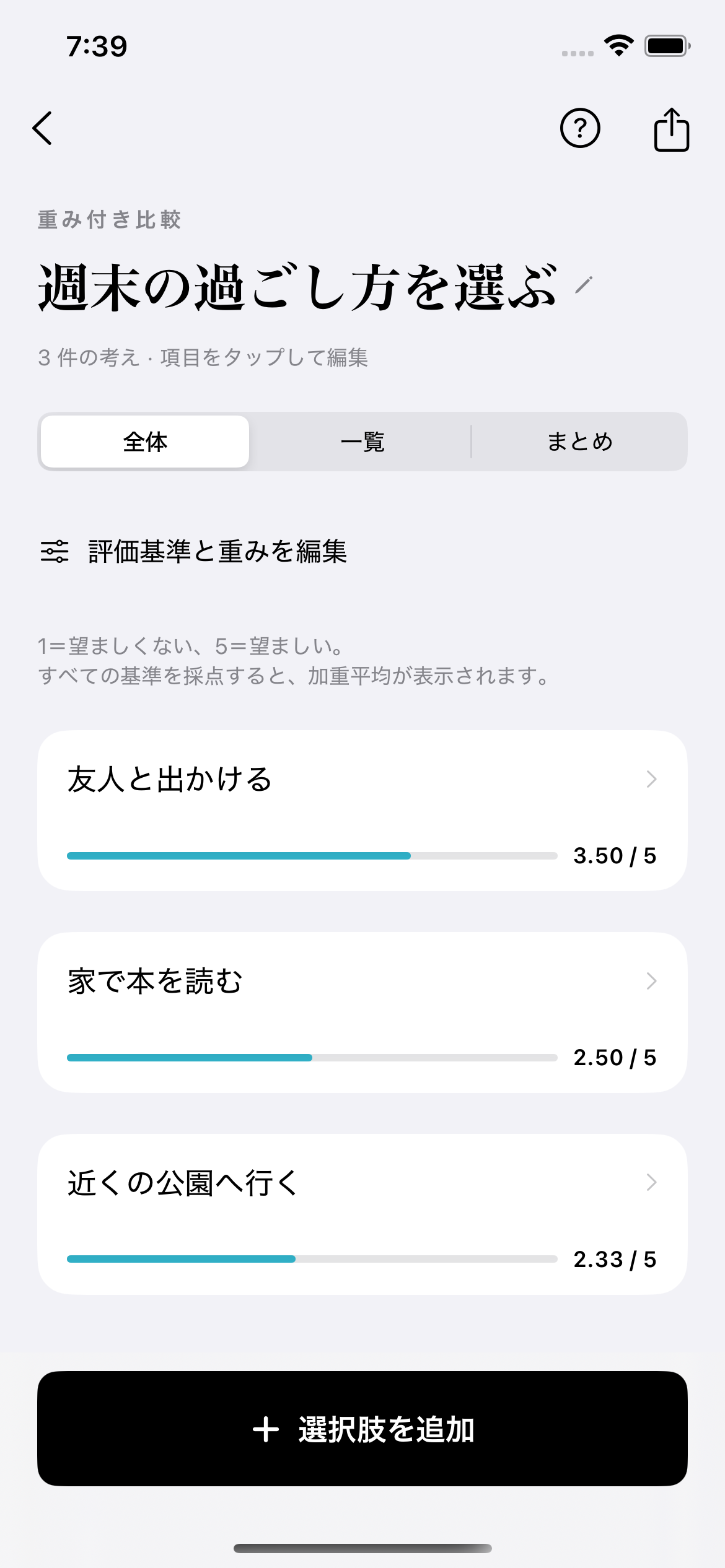
Frames — Compare options with weighted criteria
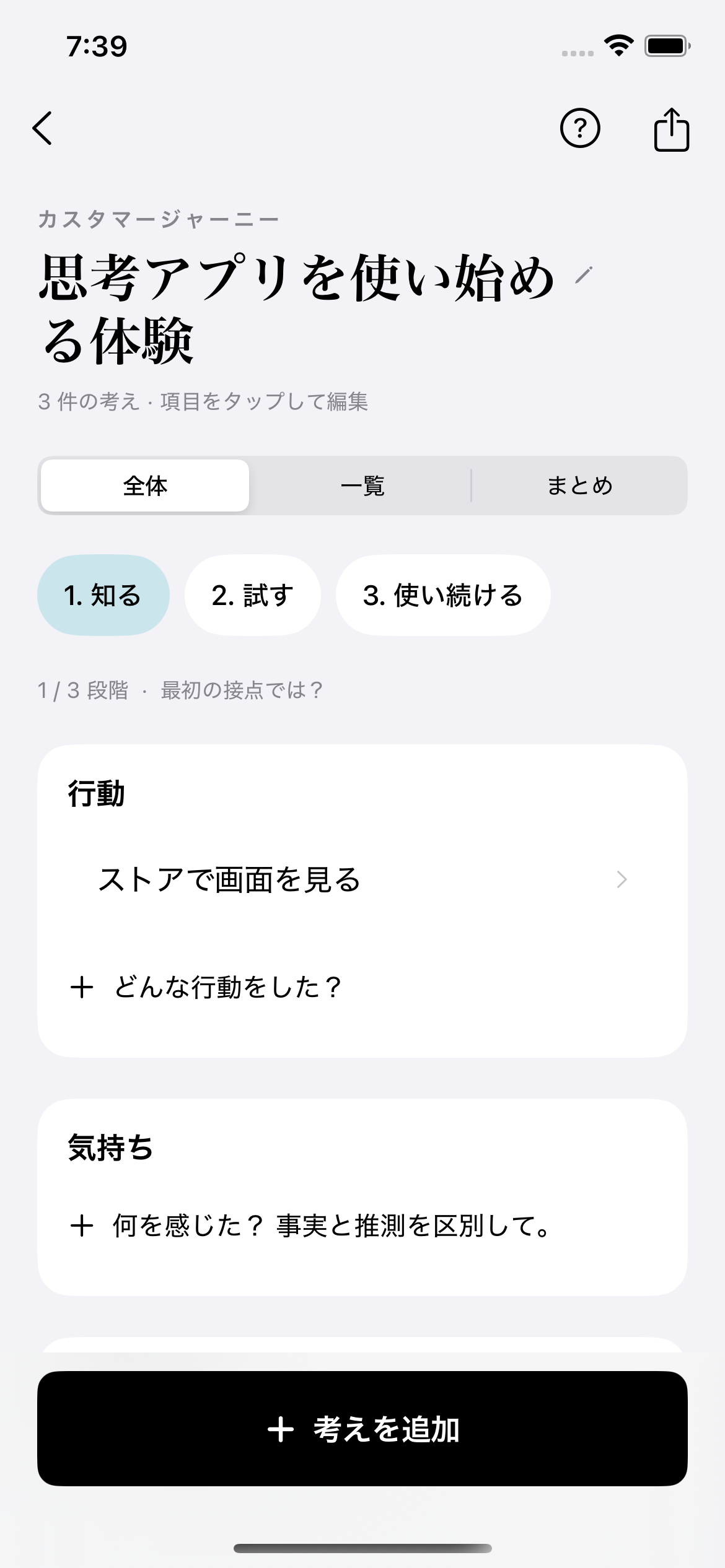
Frames — Explore an experience with a customer journey map

Actual screenshots of a development build, shown in Japanese. The interface may change before release.

In-app language

12 languages, including English, Japanese & Chinese

The submitted version supports 12 languages. It follows your device or app language preference and falls back to English for unsupported languages.

View all supported languages

English · Japanese · Spanish · Korean · Simplified Chinese · Traditional Chinese · Portuguese · Turkish · French · Tamil · Arabic · German

This page is available in: 日本語 / English / 简体中文

A few useful answers

Can I download Frames now?

Frames is currently in App Store review. A release date has not been announced.

What can I use the frameworks for?

Understand a situation, set priorities, compare options, explore causes, reflect, or plan goals. Each framework includes an explanation, prompts, and a worked example.

Can I use it on paper?

Export your note and summary as a single-page A4 PDF, or print a blank worksheet to fill in by hand. Dense notes use smaller text to fit the page.

Does it work offline?

Core features and bundled translations work offline. Reference links and sharing destinations may require an internet connection.

Data & privacy

No account required. Notes stay on your device and are not sent to the developer by the app. Core features work offline. Device-to-device synchronization is not included.

Information checked:
Currently in App Store review. A release date has not been announced.